


1. The material has high strength and low weight. Steel possesses high strength and a high elastic modulus. Compared to concrete and wood, the ratio of density to yield strength is relatively low. Therefore, under the same stress conditions, steel structures have smaller cross-sections, lighter weight, and are easy to transport and install, making them suitable for large spans, great heights, and heavy-duty structures.
2. Steel exhibits good toughness and plasticity, uniform material properties, and high structural reliability. It is suitable for bearing impact and dynamic loads and offers excellent seismic performance. The internal structure of steel is uniform, closely resembling an isotropic and homogeneous body. The actual performance of steel structures aligns with theoretical calculations, resulting in high reliability.
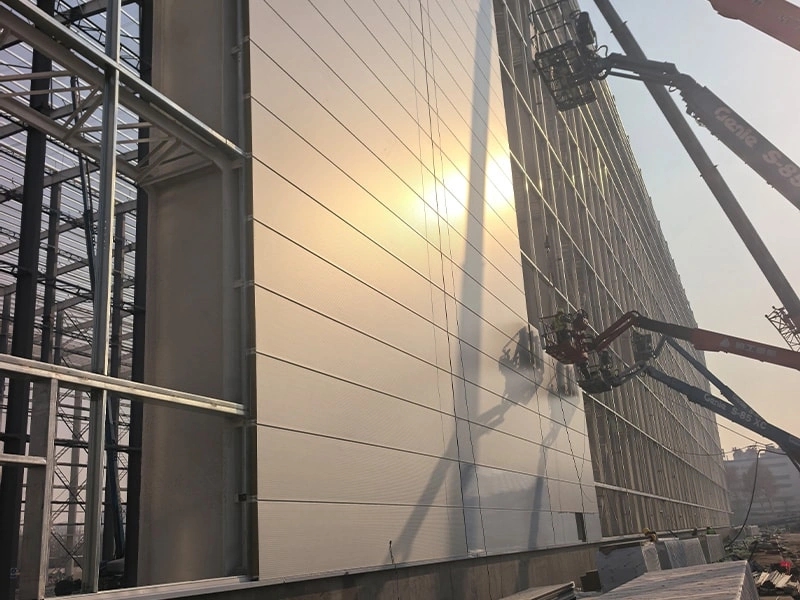
3. Steel structure manufacturing and installation are highly mechanized. Steel components are easily fabricated in factories and assembled on construction sites. The factory-based, mechanized production of steel components ensures high precision, efficiency, and fast assembly, leading to shorter construction periods. Steel structures represent a highly industrialized form of construction.
4. Steel structures provide excellent sealing performance. As welded structures can be sealed, they exhibit good airtightness and watertightness, making them suitable for high-pressure vessels, large oil tanks, pressure pipelines, and similar applications.
5. Steel structures are heat-resistant but not fire-resistant. The properties of steel change little at temperatures below 150°C. Therefore, steel structures are suitable for high-temperature workshops. However, when the structure’s surface is exposed to thermal radiation of about 150°C, insulation panels should be used for protection. When temperatures range between 300°C and 400°C, the strength and elastic modulus of steel decrease significantly. At around 600°C, the strength of steel tends toward zero. In buildings with special fire safety requirements, fire-resistant materials should be used to protect steel structures and improve their fire resistance rating.
6. Low carbon emissions, energy efficiency, environmental friendliness, and reusability. The dismantling of steel structures produces almost no construction waste, and the steel can be recycled.
